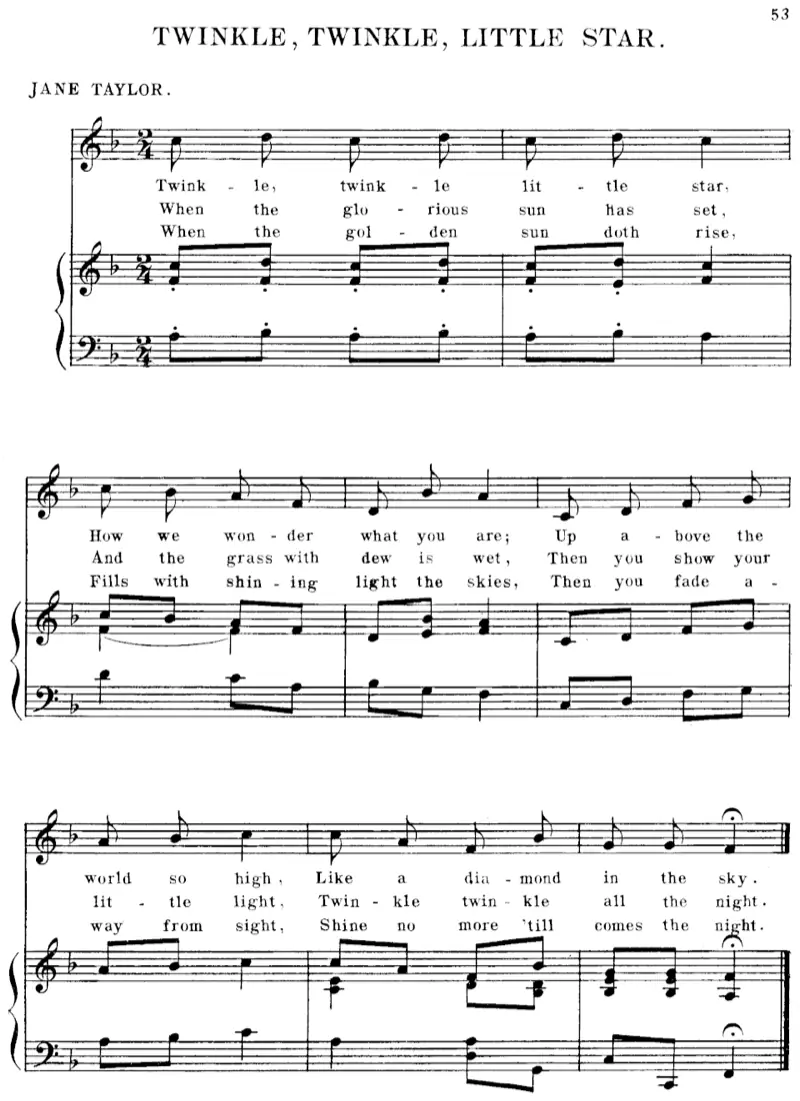
Twinkle, Twinkle, Little Star
- Jane Taylor (1783–1824)
- Composed
- 1806
- Genre
- nursery rhyme
- Level
- beginner
The hit nobody claimed
Somewhere around 1740, an anonymous French composer wrote the most famous melody in human history and then — and this is the part I respect — never told anyone. It first shows up in print in 1761, in a Paris songbook, no name attached.
You know the tune as Twinkle, Twinkle, Little Star. The French knew it as "Ah! vous dirai-je, maman", and before you get any wholesome ideas, here is what the original lyrics were about:
Ah! Shall I tell you, Mama, What causes my torment? Ever since I saw Silvandre Look at me so tenderly, My heart says every moment: "Can we live without a lover?"
Cute, right? It keeps going. The singer is a young shepherdess who is warned that beauty fades, that spring is the season for "committing", and that she'd better hurry up. By the final verse she has abandoned her crook AND her dog to run off with the man.
So yes. The melody your toddler hums at bedtime started life as a song about ditching your dog for a boyfriend before you expire. The eighteenth century was not okay.
No, Mozart didn't write it
The most persistent myth about this tune is that Mozart composed it as a child prodigy. He didn't. He did what every musician with taste has done since: he stole it. In 1781 or so, aged 25, he wrote twelve variations on the melody (K. 265), which is the classical-music equivalent of a remix album.
For years, experts insisted the variations were written in 1778, during Mozart's stay in Paris — because obviously a Frenchman's melody could only be heard in France, radio not having been invented and hummed tunes famously being unable to cross borders. They were so confident they renumbered the piece in the official catalogue. Then someone actually analysed the manuscript and found it was written years later, in Vienna. The piece now carries both numbers, K. 265/300e, like a scar.
One melody, one language, three jobs
The English lyrics arrived in 1806, when Jane Taylor published a poem called "The Star". It's five verses long, by the way — there are four more after the one you know, and nobody has ever reached them, including you, right now, mentally trying. The poem and the French tune weren't even officially introduced to each other until 1838. That's a 77-year-old melody matched with a 32-year-old poem by some anonymous matchmaker. Third anonymous hero of this story, if you're counting.
But English didn't stop there. In 1835, a Boston publisher copyrighted the Alphabet Song — same tune, marketed with a straight face as "a German air" (it's French, but sure). And "Baa, Baa, Black Sheep"? Also the same tune.
The world's most revealing personality test
Here's where it gets good. The melody drifted across Europe, and every nation looked at this blank, pleasant little tune and said: yes — this is the perfect vehicle for our deepest national preoccupations.
Germany contributed a procurement document. "Morgen kommt der Weihnachtsmann" is a Christmas song in which a child itemises every desired gift: drums, toy soldiers, a rifle, a sabre, and — because it's 1835 — an entire toy army. The child has submitted requirements. The child expects results. The text was actually written to a different melody, and only got attached to this one around 1890 — meaning Germany kept the gift list on file for 55 years until a suitable delivery vehicle became available. Bonus fact: the lyrics were written by Hoffmann von Fallersleben, the same man who wrote the words to the German national anthem. One man, two texts: one for the nation, one for the toy army. Priorities were balanced.
Hungary also summoned a gift-bearer, but went further: "Hull a pelyhes fehér hó" audits the contents of his bag (apples, hazelnuts, walnuts, sugar) and notes that the children's shoes have been left out and are to be filled by morning. A supply chain must be managed.
The Netherlands looked at the same melody and decided it was the ideal vehicle for a drama. "Altijd is Kortjakje ziek" is about a woman who is mysteriously ill every weekday but never on Sunday, when she appears in church with a Bible so encrusted with silver it functions as a wealth display. What she does on weekdays is left as an exercise for the adult listener.
Spain told a bell to ring for Jesus and not stop. Three verses. No complications.
Greece turned it into something extraordinary. "Φεγγαράκι μου λαμπρό" — "My Bright Little Moon" — is a child asking the moon to light the way to school. The story every Greek child grows up with is that these were the secret schools of the Ottoman occupation, where learning Greek was done at night, at real risk. Historians still argue about how much of that is legend.
Turkey wrote the most sincerely enthusiastic back-to-school song ever recorded. Just yesterday the children played in their mothers' arms — now the classrooms are full and everyone is thrilled. That level of excitement about school attendance should be studied.
Sweden translated the English poem, kept the star, and went to bed.
You can play it on Vitzik in whichever language you're feeling. The notes don't care. They never have.