Für Elise
- Ludwig van Beethoven (1770–1827)
- Composed
- 1810
- Genre
- classical
- Level
- intermediate
200 years of trauma
Do you know what starts romantic, becomes very hard, and ends dramatically?
No, I'm not talking about your relationship. I'm talking about Für Elise.
This piece was written over 200 years ago (dated April 27, 1810) and still manages to haunt every modern piano teacher. Yes, somewhere in the world right now there is a kid butchering it. Don't be that kid, practice now!
The saddest part is that Beethoven died without knowing it would become the most famous piano piece ever written. Ludwig van Beethoven, composer of earth-shattering symphonies, titanic concertos, and music that made God himself take notes... and yet the piece that every single human on Earth knows him for is one he didn't even judge worth publishing, written for a woman who rejected him.
Your reminder that business and love don't go well together.
More mysterious than your doctor's handwriting
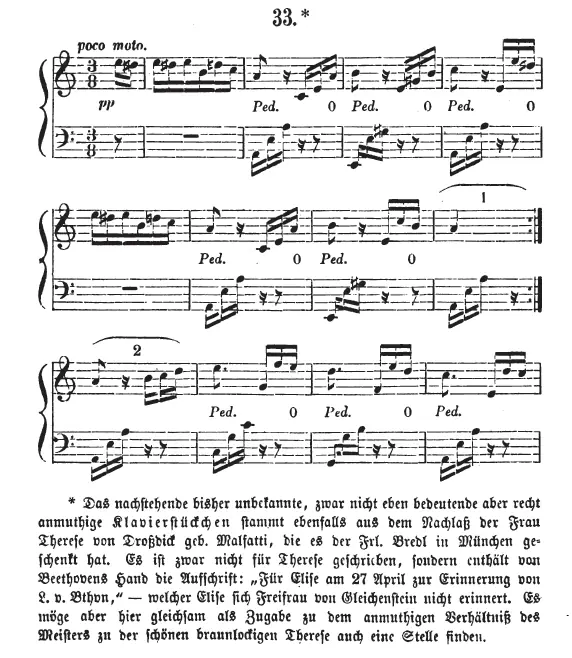
The song was discovered by Ludwig Nohl 40 years after Beethoven's death and published in 1867. People loved it, probably for its iconic intro, romantic vibes, and relative easiness to learn. Though that's up for debate once you hit the infamous middle section.
There is some internet urban legend claiming that Beethoven wrote Für Elise for one of his students that he fell in love with. Since she wasn't the best at piano, he made the beginning really easy for her. However, after learning about her engagement, he was heartbroken and wrote the rest of the song so hard that she would never be able to play it.
So maybe that explains it.
Shortly after its discovery, the original score disappeared, which only added to the mystery. The most renowned piano piece in history and the score is nowhere to be found. We're not even sure the song was called "Für Elise" at all. Beethoven's handwriting was notoriously bad, so we can't be certain the title was copied correctly by Nohl. The leading theory is that "Elise" was actually "Therese", as in Therese Malfatti, the student he proposed to in 1810 and who turned him down. There may also have been errors in the transcription of the notes themselves.
That's a lot of unknowns. Could it be that Für Elise is to music what Jesus is to religion?
How Beethoven's Legacy Became Your Nokia Ringtone
Modern times have at least restored some dignity to this piece. Sort of.
In Taiwan, Für Elise is one of two melodies played on garbage trucks to alert residents to bring out their rubbish. The trucks have been doing this since the 1960s, apparently Taiwan imported German garbage trucks that came pre-programmed with the tune. Beethoven couldn't take out Therese... but at least now he can take your trash out.
(Audience laughing)
In Sri Lanka, you can wake up to the melody blaring from tuk-tuks selling bread, cruising neighbourhoods from as early as 6:30am. Vendors are called "choon paan", literally "tune bread".
Beethoven wrote it for a woman he loved. It became the sound of garbage day and breakfast time.
Honestly, he deserved better.